





Why is comfort in buildings a strategic challenge?
Improving employee well-being, reducing energy consumption while maintaining occupant comfort, and optimizing environmental conditions: comfort management in buildings is now a key pillar of overall performance.
- Thermal, acoustic and visual comfort directly influence occupant productivity and satisfaction
- Employees expect workspaces that are comfortable, intuitive and adapted to their needs
- Measuring comfort indicators enables relevant decision-making for space planning and building operations
Without reliable and structured data, it is impossible to accurately analyze comfort conditions and ensure healthy and high-performing workspaces.
Comfort management features with SpinalCom
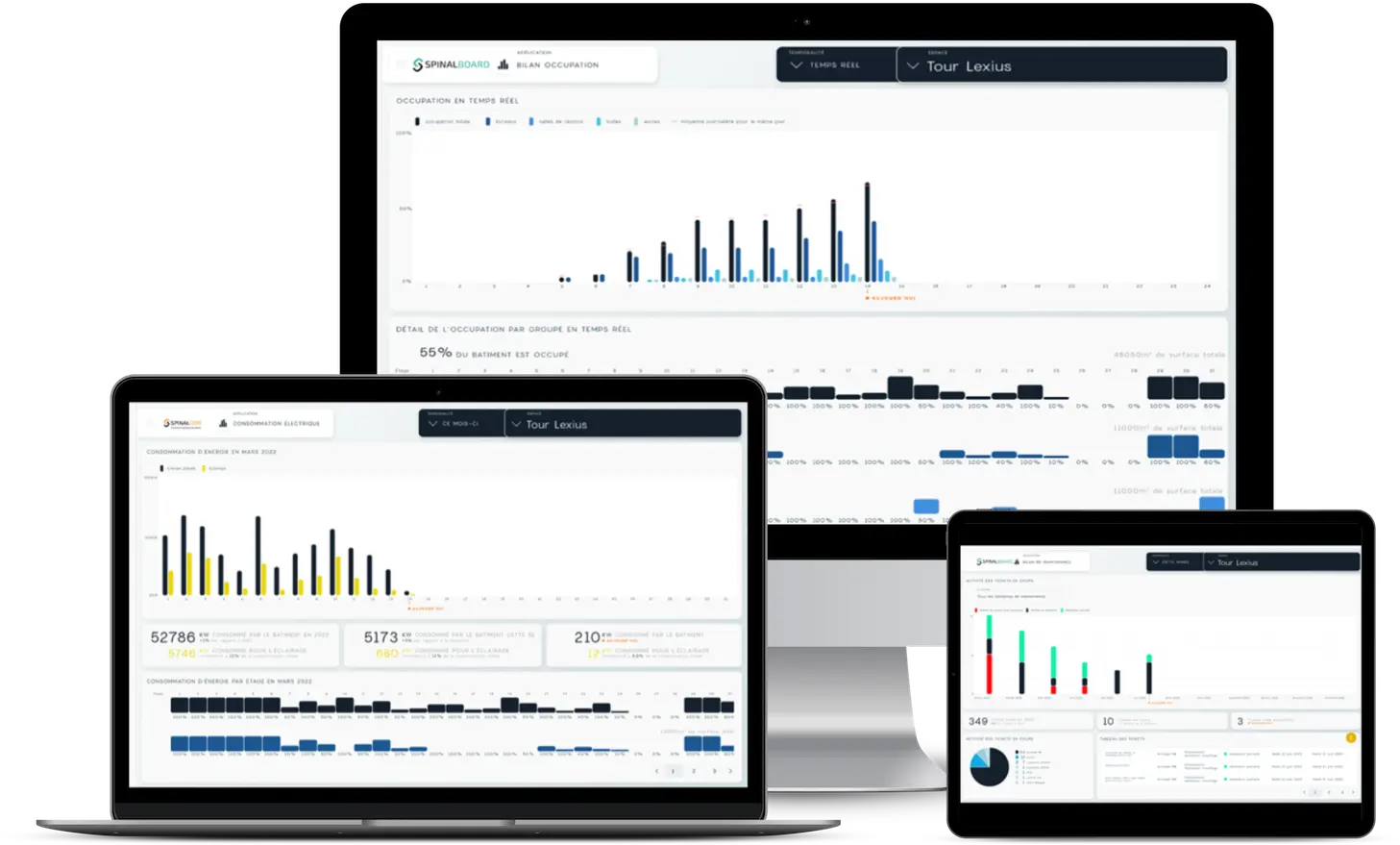
What are the concrete benefits of data-driven comfort management?
Adopting a data-driven approach, as enabled by SpinalCom, transforms the usability and comfort of your buildings. This contributes to:
- Improve occupant well-being and productivity through a healthy work environment adapted to their needs
- Reduce energy consumption by adjusting equipment according to real usage while maintaining occupant comfort
- Increase the value of your real estate assets with certified and high-performance buildings
- Meet ESG criteria with documented and optimized quality-of-work-life indicators
- Detect and anticipate equipment failures impacting comfort before they occur
- Facilitate reporting required to obtain environmental certifications
Optimize your building comfort in real time according to your usage.
Ready to switch to intelligent comfort management?
Demandez une démo
They trust us










How to carry out an accurate diagnosis of comfort and energy losses in a building?
A reliable diagnosis relies on a coherent reading of all the data already present in your building: BMS, IoT sensors, booking systems, CMMS, field reports. By unifying these data streams in a dynamic digital twin, you gain continuous visibility into temperature, humidity, air quality, occupancy, and energy consumption.
You can then identify overheated zones, balancing defects, setpoint drift, or energy-intensive behaviors. The contextual analysis provided by a BOS such as SpinalCore helps you understand the causes: ageing equipment, inadequate control systems, temporary overcrowding, poorly managed ventilation.
What technical solutions can genuinely improve comfort in a building
A comfortable building relies on reliable data and tools capable of taking action. By combining several technology building blocks connected to a unified BOS, you can automate, adjust, and monitor your spaces without multiplying software solutions.
- Intelligent HVAC control based on actual occupancy
- Drift detection through continuous data analysis and contextual alerts
- Dynamic usage scenarios (peak hours, events, meetings, off-peak periods)
- Air quality monitoring and ventilation automation
- Complementary IoT sensors to refine measurements
- Comfort-energy dashboards to visualise non-compliant zones
- Synchronisation with the CMMS to anticipate maintenance interventions
These solutions improve perceived temperature, room ventilation, acoustics, lighting, and the building’s responsiveness to occupancy changes.
How to define the right KPIs to measure comfort and calculate ROI
Only actionable indicators tied to a specific objective should be retained: reducing energy consumption, improving the user experience, or optimising maintenance. The digital twin structures the data to create consistent and comparable KPIs, regardless of the system that generates them.
Examples of KPIs: thermal stability, non-compliance rate by zone, average time spent outside the comfort range, air renewal rate, occupancy/consumption correlation, energy cost per m² of used space. These indicators make it possible to link comfort to quantifiable operational and energy savings.
How to integrate renewable energies and energy flexibility into comfort management
The BOS synchronises solar production, storage, HVAC systems, and actual space usage to maintain consistent comfort. Energy flexibility relies on simple rules: adjusting setpoints according to energy availability, anticipating peaks using forecast data, and taking advantage of favourable periods to pre-heat, pre-cool, or ventilate.
By connecting all these sources to your digital twin, you achieve coherent control that maintains comfort while reducing energy loads and emissions.
What sets comfort management apart from a BMS?
A BMS controls equipment; comfort management controls uses, real-world conditions, and occupancy behaviours. In a BMS, data flows in silos and each system follows its own logic.
Comfort management relies on a BOS that unifies information: linking occupancy, ventilation, field measurements, air quality, energy consumption, and user feedback. This gives you a cross-cutting view capable of indicating where, when, and why a space becomes uncomfortable.
How to calculate the return on investment of a comfort management project?
Combine energy, operational, and usage gains. The digital twin provides before/after comparative data: reduction in energy consumption, decrease in time spent outside the comfort zone, fewer corrective maintenance interventions, and improved actual space occupancy.
ROI is based on a comparison of current operating costs against post-optimisation costs. Savings generated by proper HVAC control, adjusted ventilation, more targeted maintenance, and the reduction of underperforming spaces make it possible to define a measurable payback period.
The unified platform makes it possible to track these indicators over time and clearly document the benefits achieved.