




A data integration platform for truly smart buildings
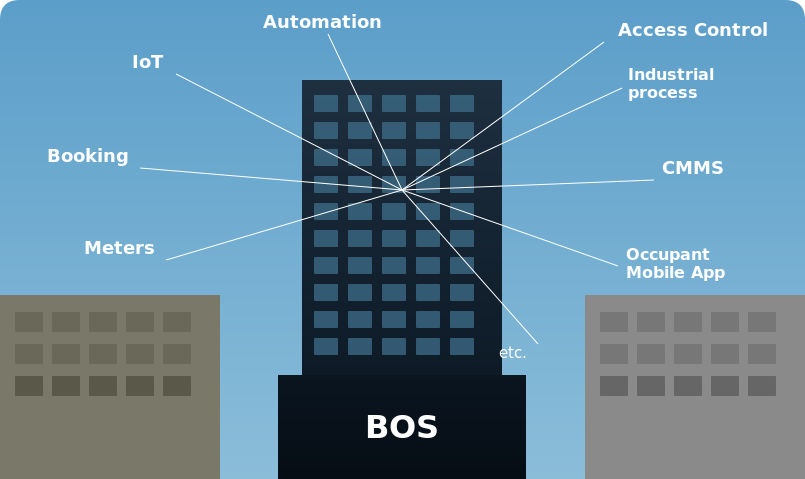
A data integration platform is a system that centralizes, structures and synchronizes heterogeneous data from multiple sources: connected equipment, PLCs or BMS monitoring and control interfaces, IoT sensors, business software, third-party applications or static real estate data. It plays a fundamental role in complex environments such as smart buildings, smart factories, smart hospitals or smart airports, where the multiplicity of systems makes a unified and interoperable approach essential.
At SpinalCom, our Building Operating System (BOS) is based on SpinalCore, a data integration platform unique on the market: it not only unifies building, asset and usage data, but structures them in a single digital source of truth backed by a true dynamic digital twin.
An open architecture for a unified and interoperable data integration platform
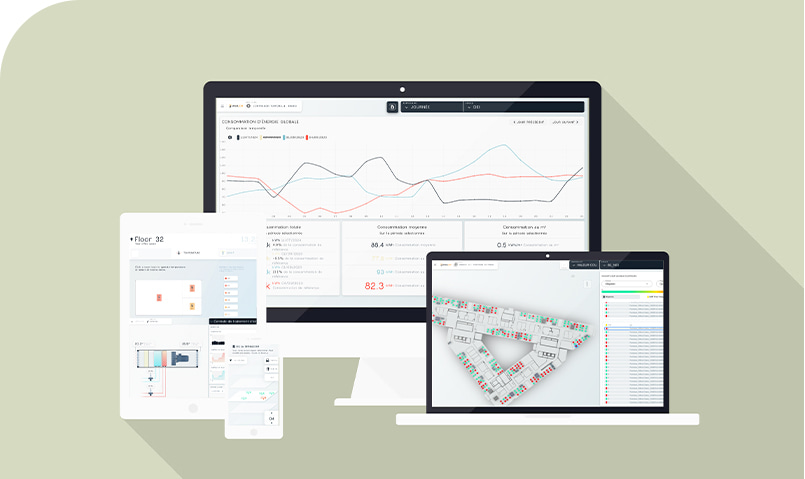
Unlike traditional platforms or static proprietary databases, SpinalCore is a semantic data integration platform, natively designed for complex-built environments.
It is based on an asynchronous semantic graph data hub capable of:
- Integrating building data (floors, zones, rooms…),
- Integrating asset data (sensors, equipment, machines, objects…),
- Connecting usage data (measurement points, alerts, CMMS tickets…),
- Synchronizing data in real time via OPC UA, BACnet IP, API connectors…
- Maintaining data consistency through a single dynamic single source of truth unique.
SpinalCore, is also an integrated event engine, which orchestrates automated processes between different systems (maintenance, energy, monitoring and control, occupant applications, analytics, AI, etc.). Thus, this data integration platform becomes not only a convergence foundation, but a lever for operational performance.
Concret benefits for every stakeholder


Key figures on data integration platforms
70 %
of data collected in smart buildings remains unused due to lack of integration between systems (source: McKinsey)
30 to 40 %
average reduction in application integration costs for companies that have implemented a data integration platform (source: IDC)
50 %
improvement in data quality by unifying real estate and asset data into a single source of truth (source: Digital Twin Consortium)
ROI < 18 months
with an operational digital twin backed by a data integration platform (source: Gartner)
Request a demonstration of our data integration platform
Would you like to leverage a data integration platform capable of connecting your equipment, software and business processes into a unified data foundation?
Discover how SpinalCore can become the operational heart of your smart building, smart factory, smart hospital or smart airport projects.
They trust us





FAQs
What is data integration ?
Data integration is a process that combines information from different sources to provide a single, unified view to users, facilitating data reading and exploitation. The main objective is to simplify analysis for commercial, decision-making or operational needs, by grouping disparate data in the same environment.
Common techniques include ETL (Extract, Transform, Load), which extracts, transforms and loads data, and ELT (Extract, Load, Transform), which extracts and loads data before transforming it, enabling more flexible and faster management of large volumes.
These two techniques are not suited to Smart Building needs, hence SpinalCom’s development of a unique asynchronous semantic graph datahub on the market.
The 5 different types of integration platforms
Traditional ETL platforms: Extract, transform and load data into a central warehouse. Suited to stable environments with planned flows and structured data.
Modern ELT platforms: Load data into the target storage first, then transform it directly in the database. Optimized for large volumes and unstructured data.
Real-time integration platforms: Synchronize and process data instantly, useful for rapid decisions and IoT or critical environments.
Hybrid platforms: Combine ETLand real-time to manage multiple data types, structured or not, with planned flows and instant processing.
Asynchronous integration platforms: Synchronize and process transactional data (non-real-time, such as a CMMS ticket), time-series (real-time) and 3D objects within a single datahub.
Why data integration is so important
Optimize quality and consistency: Cleans and harmonizes information from different sources, eliminating duplicates and inconsistencies for reliable data.
Facilitate decision-making: A unified view of data enables more relevant decisions and better team responsiveness.
Improve operational efficiency: Reduces information silos and promotes collaboration and optimization of internal processes.
Foster innovation: A complete view of data facilitates the identification of new opportunities and encourages creativity.
What are the different layers of a data platform?
Ingestion :Collects data from different sources, sensors, internal or external systems, and business applications.
Storage: Cleaning, enrichment and structuring of data to make them usable and consistent.
Transformation: Nettoyage, enrichissement et structuration des données pour les rendre exploitables et cohérentes.
Distribution: Making data available to end users via dashboards, APIs or analysis tools, facilitating decision-making.
Essential criteria for choosing a data integration tool
Compatibility: Must integrate easily with existing systems, software and databases. Scalability: Handle increasing volumes without slowdown, in line with company growth.
Scalability : Handle increasing volumes without slowdown, in line with company growth.
Ease of use: Intuitive interface, reduced learning curve.
Cost: Return on investment to be assessed against time savings, efficiency and data quality.
Main challenges of data integration
Data quality: Data may be inaccurate, incomplete or inconsistent, requiring cleaning and validation.
Technical complexity: Integrating heterogeneous systems and managing varied formats requires appropriate skills and tools.
Security and confidentiality: Protecting sensitive data during transfer and storage to comply with regulations.
Cost and resources: Implementing and maintaining solutions requires time, money and qualified teams.