




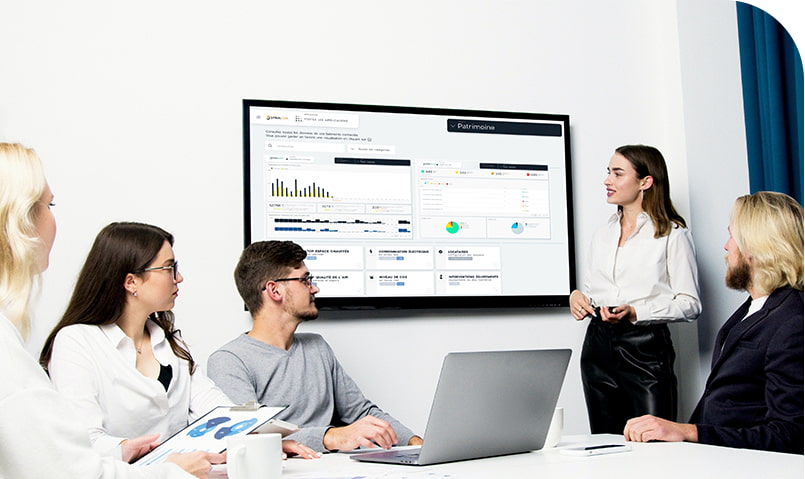
What is an IoT platform?
An IoT platform (Internet of Things) connects physical objects to digital systems via the Internet or industrial networks, in order to collect, analyze and leverage data in real
In the smart building, smart factory, smart hospital or smart airport sectors, it plays a key role in automating operations, anticipating failures, improving energy efficiency or enhancing security.
The SpinalCore platform, at the heart of our Building Operating System, natively integrates the features of a real-time IoT platform, while offering an interoperable and unified architecture, capable of simultaneously managing real-time, transactional, asset and building data.
An open architecture for seamless digitalization
Our IoT platform is based on an open infrastructure, which facilitates the collection, processing, visualization and control of data, regardless of its origin or format:
- Native connectors to industrial and IoT protocols: BACnet, Modbus, MQTT, OPC-UA, REST API, etc.
- Multi-sensor support : temperatures, CO₂, presence, water, gas or electricity consumption, opening and vibration sensors, etc.
- Cloud or on-premises deployment with local IoT gateway (edge computing) for sensitive or isolated sites
- Storage and processing of large volumes of real-time data, scalable by design
- Native interoperability with other SpinalWall modules (CMMS, energy, monitoring and control, space management, etc.)
- Unified API to rapidly develop applications or interconnect third-party systems
- End-to-end security with access management, auditability and sovereign hosting

What are the advantages of our IoT platform?
Our IoT platform offers concrete benefits to every stakeholder and addresses the challenges of complex buildings and sites.
- Operators / Maintenance teams: : visualize equipment status in real time, automate alerts and reduce intervention times. Through better equipment lifecycle management, you significantly reduce your operating costs.
- Technical managers / CIOs: : standardize IoT data flows, secure connections and facilitate multi-site supervision.
- Owners / Asset managers : enhance your assets with R2S, BACS, or SmartScore compatible infrastructures.
- Engineering firms / Project owners’ representatives : specify a scalable, interoperable and 100% sovereign solution from the design phase.
- Occupants : benefit from contextualized services (comfort, booking, assistance, guidance…) made possible by unified IoT data.
Key figures of our IoT platform
+40 millions
IoT data points processed every day on a single deployment
100%
interoperable with BMS equipment, CMMS and business applications
1 single
source of truth for all your data: real-time, building, equipment…
Cloud or On-Premises
deployment possible, including in hospital or industrial environments
0 middleware required:
connectivity and orchestration natively integrated in the BOS
Manage your building’s IoT with a scalable and sovereign platform Our IoT platform is already in production on commercial buildings, industrial sites and high-demand corporate headquarters.
Request a demoThey trust us









How to choose the best IoT platform
To select an IoT platform suited to complex buildings and sites, start by defining your needs: equipment management, predictive maintenance, energy optimization or process automation.
Criteria to consider:
- Needs definition: priority objectives (monitoring and control, maintenance, occupant comfort, energy monitoring).
- Technical criteria: compatibility with your equipment (BMS, CMMS, IoT sensors), connectivity (Wi-Fi, LPWAN, LORAWAN, 5G) and capacity to evolve with your projects.
- Financial aspects: pricing model, integration and maintenance costs.
- Security and compliance: data encryption, protection protocols and compliance with local regulations.
- Support and community: technical assistance, documentation, forums and user feedback.
Why integrate an IoT solution
A cloud or on-premises IoT solution offers many advantages:
- Deployment flexibility: choose between cloud, on-premises or a hybrid model depending on your needs and constraints.
- Scalability :easily manage thousands of sensors and equipment without technical complexity.
- Cost reduction: adapt your infrastructure to control your investments and operating costs.
- Accessibility : control and supervise your equipment from anywhere, securely.
- Enhanced security: benefit from regular updates and advanced data protection protocols.
- Advanced integration: leverage your data through analytics and artificial intelligence tools to optimize your buildings
The 3 pillars of an IoT platform
A high-performing IoT platform is based on:
- Connected sensors and devices: measuring temperature, humidity, energy consumption, air quality, presence…
- Connectivity : reliable transmission via Wi-Fi, LPWAN, 5G or industrial protocols (BACnet, Modbus, MQTT).
- Processing and analysis platform: storage, visualization and automation of actions for building operation and maintenance.