



What is SCADA monitoring & control?
SCADA monitoring & control (Supervisory Control and Data Acquisition) is a software system designed to remotely monitor, collect and control data from industrial processes or technical infrastructures. It is widely used in critical environments such as factories, hospitals, airports or railway stations, where technical equipment must be monitored continuously, sometimes 24/7.
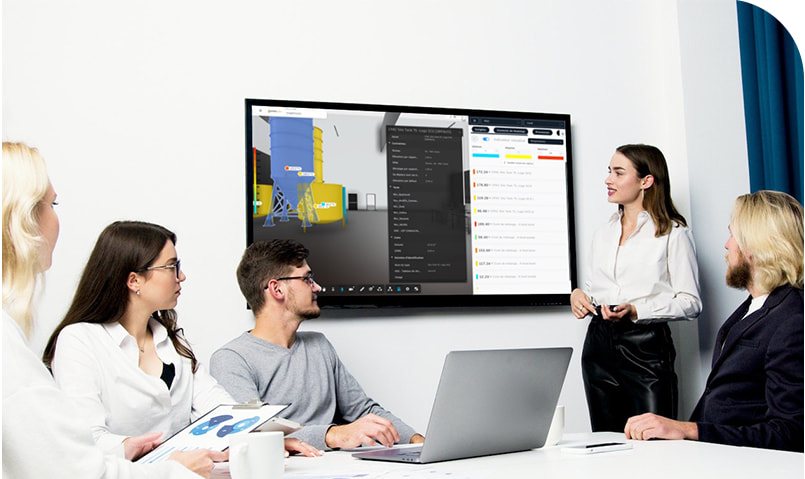
With SpinalCom, SCADA monitoring & control functions are directly integrated within our unified platform. Based on a modern, interoperable architecture, our solution enables real-time monitoring & control of all types of equipment, from HVAC systems to industrial machine tools, in a secure, on-premise deployable environment.
An open architecture for seamless digitalization
Unlike traditional SCADA solutions that are often siloed, the SpinalCom platform is built on an interoperable foundation capable of natively communicating with your entire ecosystem:
- BMS, industrial IoT, PLCs, connected sensors
- MES (Manufacturing Execution System) systems
- Enterprise ERP or CMMS
- Business databases or private cloud
This architecture guarantees smooth and scalable integration, while ensuring active control of installations via adapted business interfaces. You can connect, supervise, analyze and control your equipment from a single intuitive web interface, accessible from your internal networks or remotely depending on your security requirements.

SpinalCom’s SCADA software: Concrete benefits for every stakeholder
| Role | Benefits / Content | |
|---|---|---|
| 1 | Operations Manager | Has a centralized real-time view across all sites and technical installations |
| 2 | CIO / CISO | Benefits from on-premise or hybrid deployment, integrable with existing IT tools |
| 3 | Technical Teams | Quickly access alerts, history, real-time graphs and technical documents |
| 4 | Industrial Management / Maintenance | Optimizes operational efficiency, asset availability and decision-making |
Key figures on SCADA monitoring & control
80%
of modern factories use a SCADA solution to control their equipment (source: ARC Advisory Group)
60 000
data points can be transmitted in real time on a connected hospital
< 2 secondes
average data refresh time on our interface
100%
of data hosted on-site in SpinalCom on-premise deployments
+30
protocols/APIs natively supported via our standard connectors
Discover a next-generation SCADA monitoring & control software
Our SCADA monitoring & control solution is designed for demanding environments where data integrity, service continuity and security are absolute priorities. Whether you are an industrial player, a healthcare institution or a transport operator, our platform allows you to regain control of your data, without depending on rigid proprietary architectures.
Thanks to our 100% French sovereign solution developed in-house, we master all technology building blocks, including our asynchronous semantic graph datahub – a unique innovation on the market! This total independence guarantees you true digital sovereignty, optimal data security, flawless technical consistency and a continuous capacity for innovation.
They trust us







What are the main functions of SCADA software?
Automated control of technical installations: SCADA systems allow you to automatically control all your building equipment, such as HVAC, lighting, access systems or energy management. Smart sensors and devices detect anomalies, trigger alerts and reduce manual interventions.
Real-time data collection and analysis: SCADA centralizes and analyzes data from sensors and PLCs, enabling performance monitoring, fault anticipation and energy consumption optimization.
Monitoring and alert management: Continuous anomaly detection and immediate transmission to teams to intervene quickly and ensure occupant safety.
Intuitive Human-Machine Interface (HMI): Displays data clearly to supervise and control equipment, even for non-technical teams.
How to choose the right SCADA software?
When selecting a SCADA solution, priority should be given to:
- Connectivity with your existing equipment (HVAC, lighting, security, IoT).
- Compatibility with different industrial and IoT protocols.
- Data analysis and visualization capabilities to optimize comfort, consumption and maintenance.
- Security of data exchanges to protect sensitive building information.
- Quality of technical support to ensure smooth integration and effective management.
What are the main components of a SCADA system?
| Components | Roles |
|---|---|
| Sensors | Measure critical variables and transmit data to the SCADA/td> |
| RTU (Remote Terminal Units) | Collect information and execute local commands |
| PLC (Programmable Logic Controllers) | Automate equipment operation based on received data |
| HMI | Displays data, enables monitoring & controlof systems |
| Communication Infrastructure | Ensures reliable data transmission between all components |
Which sectors use SCADA systems?
- Energy: consumption optimization and management of electrical or thermal networks
- Commercial buildings and smart buildings: control of HVAC, lighting, elevators and security
- Water and wastewater: monitoring of pumping stations and treatment processes
- Food and beverage production: control of production lines and quality
- Pharmaceutical and chemical industry: monitoring & control of critical processes and standards compliance
What are the main advantages of SCADA software?
- Improving productivity by automating technical tasks and processes
- Saving time through continuous monitoring & control and real-time alerts
- Optimizing costs by reducing manual interventions and breakdowns
- Remotely supervising all installations from a computer or mobile device
- Facilitating decision-making through data analysis and visualization
- Reacting quickly to irregularities to ensure the safety of occupants and infrastructures
What is the role of a SCADA engineer?
The SCADA engineer designs, installs, configures and optimizes the monitoring & control of buildings or industrial installations. They supervise day-to-day operations, ensure maintenance, oversee security and collaborate with technical teams to guarantee reliable operation.
Approximate salary: France: €43,000 / year